
What Can Sound, Sand, and Neuroscience Teach Us About Healing?
For centuries, sand has been a medium through which humans have expressed stories, emotions, and meaning. Today, science is beginning to reveal fascinating insights into the sensory feedback of sand and why working with it can be so powerful in therapeutic settings. While Sandplay Therapy was developed long before modern neuroscience, emerging research suggests that many of its healing mechanisms align remarkably well with what we now understand about the brain, sensory regulation, and human development.
One of the most intriguing scientific phenomena involving sand is known as cymatics. When sound vibrations are applied to a surface covered in sand, the grains reorganize themselves into intricate geometric patterns. Different frequencies create different arrangements, revealing that invisible forces can create visible order. Physicists have studied these patterns, known as Chladni figures, for more than two centuries. While this phenomenon does not explain psychotherapy, it offers a compelling metaphor: beneath apparent chaos lies an innate tendency toward organisation and pattern.
The human nervous system functions in a surprisingly similar way. Trauma often disrupts our internal sense of order. Experiences become fragmented, emotions become disconnected from words, and memories may remain trapped in sensory and emotional networks rather than being fully integrated. Neuroscience now shows that healing frequently occurs not only through thinking and talking, but also through sensory and embodied experiences that help the brain reorganise itself.
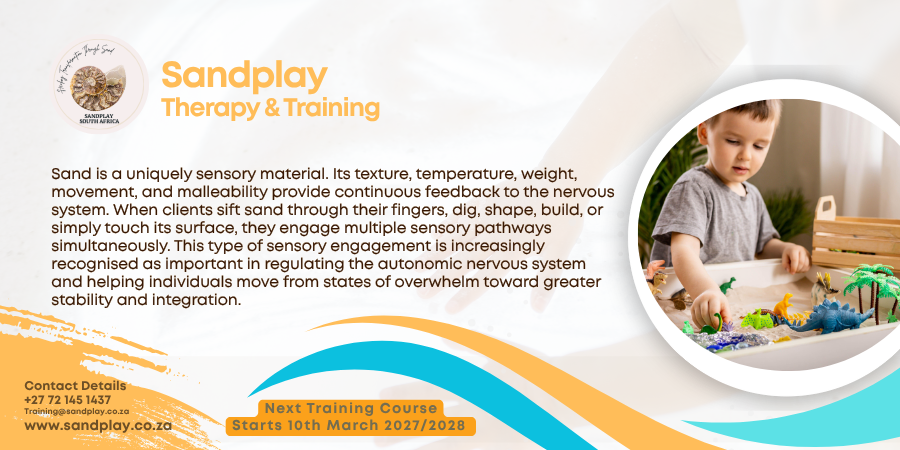
This is where sand becomes particularly interesting. Sand is a uniquely sensory material. Its texture, temperature, weight, movement, and malleability provide continuous feedback to the nervous system. When clients sift sand through their fingers, dig, shape, build, or simply touch its surface, they engage multiple sensory pathways simultaneously. This type of sensory engagement is increasingly recognised as important in regulating the autonomic nervous system and helping individuals move from states of overwhelm toward greater stability and integration.
Researchers exploring the neurobiology of Sandplay Therapy have proposed what has been called a “sensory feedback loop.” Through the interaction of hands, eyes, body sensations, imagination, and symbolic expression, clients engage both lower brain structures associated with survival and emotion, as well as higher cortical regions involved in meaning-making and reflection. This process reflects what trauma specialists often describe as “bottom-up” healing—working through the body and sensory systems rather than relying exclusively on verbal processing.
Modern neuroimaging studies have also begun exploring what occurs in the therapeutic relationship during Sandplay. Findings suggest that meaningful nonverbal interaction can involve synchronisation between therapist and client at multiple levels, supporting emotional attunement and the development of safety. Such findings resonate strongly with Dora Kalff’s original concept of the “free and protected space,” where healing emerges naturally when individuals feel sufficiently contained and witnessed.
Importantly, the science does not suggest that sand itself possesses magical healing properties. Rather, it highlights how sensory experience, symbolic expression, relationship, and nervous system regulation interact to facilitate psychological growth. The sand becomes a bridge between inner experience and outer expression, allowing material that may be difficult to verbalise to emerge in a safe and tangible form.
Perhaps the greatest lesson from both physics and psychology is that order often emerges from processes that initially appear chaotic. Just as vibration can organise grains of sand into meaningful patterns, the psyche possesses its own innate tendency toward healing and integration when provided with the right conditions. In Sandplay Therapy, we witness this process repeatedly: stories finding form, emotions finding expression, and fragmented experiences gradually reorganising into a more coherent sense of self.
As neuroscience continues to evolve, it increasingly supports what Sandplay therapists have observed for decades: healing is not only a cognitive process. It is Sensory feedback, relational, symbolic, embodied, and deeply human. The humble grain of sand may be one of the most powerful reminders of this truth.
Ready to expand your therapeutic toolkit?
Applications are now open for my One-Year Sandplay Therapy Training commencing in 2027. This comprehensive training is designed for mental health professionals who wish to integrate Sandplay into their existing practice or develop it as a powerful standalone modality. If you would like to learn more about the training, curriculum, supervision requirements, and how Sandplay can enhance your professional work, I invite you to get in touch. Message me today to explore whether this transformative journey is right for you. celia@sandplay.co.za
FAQ – What is Sensory Feedback
Sensory feedback in Sandplay Therapy refers to the continuous, embodied loop of information that arises through the client’s direct physical engagement with sand, water, and symbolic objects. As the hands touch, move, and shape the sand, the nervous system receives real-time tactile, proprioceptive, and visual input, which helps regulate arousal and supports integration between sensory, emotional, and cognitive processing systems. This “bottom-up” Sensory feedback feedback loop is particularly significant in trauma work, where verbal access may be limited; the sensory experience provides a nonverbal pathway for expression and organisation of internal states. Over time, this interaction between body, material, and symbol allows implicit emotional material to become more consciously available, supporting gradual integration and psychological coherence within the therapeutic process.
FAQ – What is the sensory world
The sensory world of a being refers to the unique way it experiences and understands reality through its senses, emotions, memories, and bodily awareness. Through sight, sound, touch, taste, smell, movement, and internal sensations, a being gathers information about its environment and itself. These sensory experiences are not merely physical events; they are filtered through attention, shaped by past experiences, and imbued with emotional and symbolic meaning. As a result, each being inhabits a subjective reality, perceiving and responding to the world in ways that are deeply personal and influenced by both biological capacities and psychological processes.
Follow me on Facebook

Comments are closed