
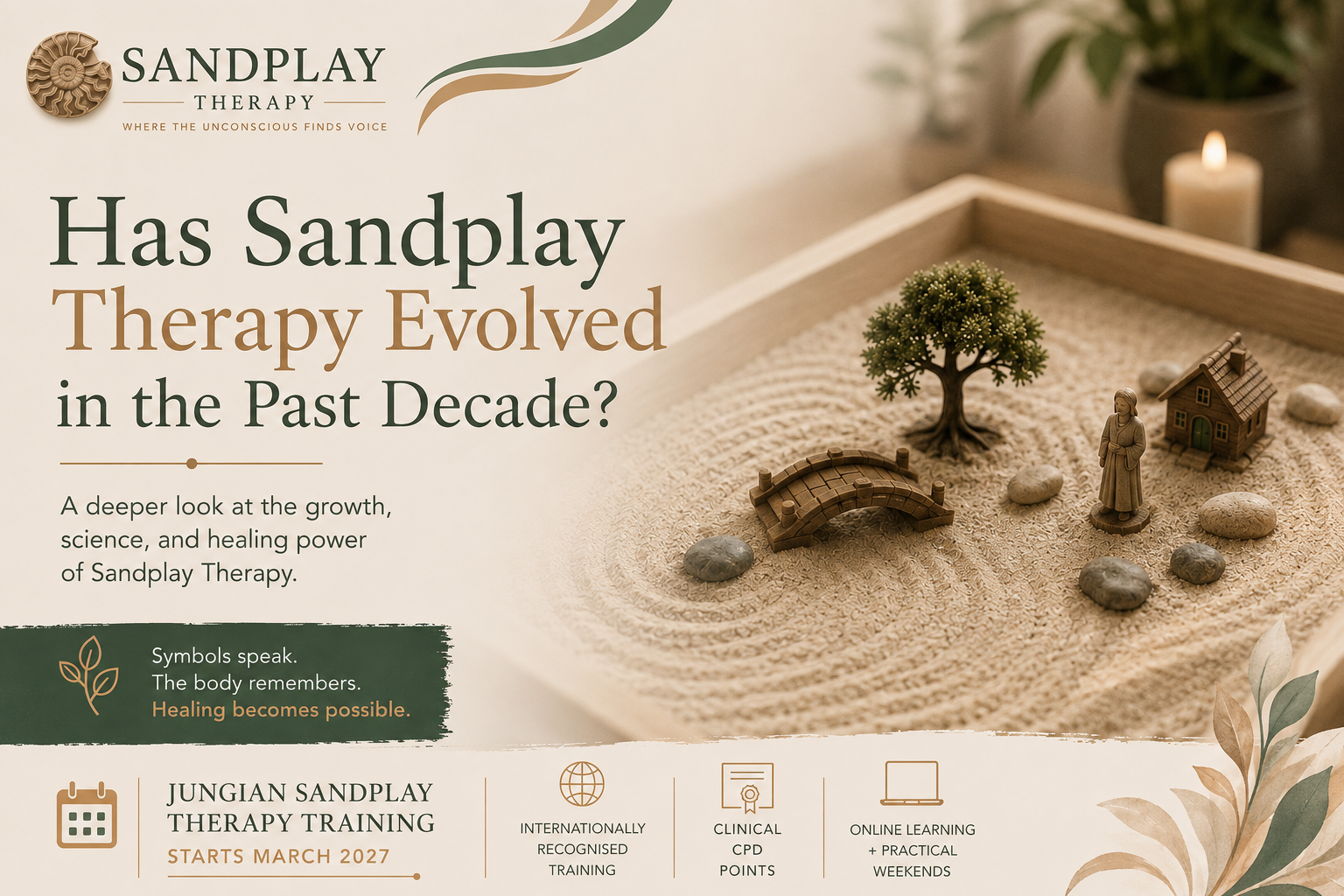
Yes. Sandplay therapy has evolved considerably over the past decade, not by abandoning Dora Kalff’s Jungian foundations, but by integrating modern neuroscience, attachment theory, trauma research, and evidence-informed practice. The core method remains the same, using symbolic play within a protected therapeutic space, but our understanding of why it works has become much more sophisticated.
Trauma-informed neuroscience
Perhaps the most significant development has been the integration of interpersonal neurobiology and trauma science.
Researchers and clinicians now understand that traumatic memories are often stored as:
- Sensations
- Emotional states
- Implicit (non-verbal) memory
- Autonomic nervous system responses
Rather than as coherent verbal narratives. This aligns remarkably well with sandplay, because clients do not need to explain their trauma before healing can begin. Modern trauma clinicians now recognise that symbolic, sensory experiences can access neural networks that talking alone often cannot.
Stronger understanding of attachment
Attachment theory has transformed the way therapists interpret sand trays. Today therapists look at:
- distance between figures
- boundaries
- bridges
- empty spaces
- repetitive themes
- abandoned children
- protective animals
- enclosed versus open worlds
- These are viewed alongside attachment styles rather than simply Jungian symbolism.
This has greatly expanded clinical usefulness.
Polyvagal Theory
Stephen Porges’ Polyvagal Theory has had enormous influence. Many therapists now understand the tray as a reflection of nervous system states.
For example:
- organised tray → regulation
- chaotic tray → survival activation
- frozen landscapes → dorsal vagal shutdown
- gradual movement toward connection → nervous system integration
This gives therapists another lens through which to understand healing.
Better integration with other therapies
Ten years ago many therapists practised sandplay as a stand-alone modality. Today it is commonly integrated with:
- EMDR
- Somatic Experiencing
- Internal Family Systems (IFS)
- Sensorimotor Psychotherapy
- Attachment-based psychotherapy
- Trauma-focused CBT (where appropriate)
Rather than competing, these approaches often complement one another.
Greater emphasis on non-verbal healing
Modern psychology increasingly acknowledges that not all healing happens through language.
Many clients:
- cannot describe childhood trauma
- become overwhelmed when talking
- intellectualise emotions
- dissociate during conversation
Sandplay provides a route that bypasses these barriers.
Growing evidence base
While sandplay research is still developing, the past decade has produced increasing evidence showing improvements in:
- PTSD symptoms
- anxiety
- depression
- emotional regulation
- resilience
- self-concept
- trauma recovery
- childhood behavioural difficulties
There is also more qualitative research demonstrating long-term personality integration and improved psychological wellbeing.
Greater cultural sensitivity
Modern practitioners are more aware that symbols differ across cultures. Instead of assuming universal meanings, therapists now explore:
- personal symbolism
- family narratives
- spiritual traditions
- cultural myths
- indigenous symbols
This makes interpretation more respectful and clinically accurate.
Increased use with adults
Historically many people associated sandplay with children. Over the last decade it has become increasingly recognised as a powerful modality for adults experiencing:
- developmental trauma
- grief
- burnout
- identity crises
- relationship difficulties
- complex PTSD
- life transitions
Many adults who struggle to articulate emotions find symbolic expression deeply therapeutic. What has Sandplay brought to the therapeutic field? It has reinforced a profound truth that modern neuroscience increasingly supports:
Healing does not always begin with words. Sometimes it begins with safety, symbolism, and experience. Sandplay has contributed several important ideas to psychotherapy:
- The unconscious can organise healing when given a safe container.
- Symbolic expression often reaches material inaccessible through conversation.
- The body remembers experiences that the mind cannot always verbalise.
- Psychological integration is often an experiential process rather than an intellectual one.
- Presence and attunement from the therapist can be as healing as interpretation.
The future of Sandplay
The next phase of Sandplay is likely to involve even closer integration with neuroscience. Future research may include:
- Functional brain imaging to study changes during and after sandplay.
- More outcome research comparing sandplay with other trauma therapies.
- Expanded applications in neurodivergent populations.
- Increased use in trauma recovery, attachment disorders, and complex grief.
- Greater collaboration between Jungian analysts, psychologists, psychiatrists, occupational therapists, and neuroscientists.
In many ways, the field has come full circle. Dora Kalff intuited that healing could occur through symbolic play in a protected space long before neuroscience could explain why. Today’s advances suggest that her insights were not replaced by modern science, they are increasingly being understood and supported through it.

Comments are closed