
Therapist Training and Therapy has evolved considerably since Freud’s psychoanalysis in the early 1900s, which explored the unconscious through methods such as free association. Behaviourism emerged in the 1920s through the work of Watson and Pavlov, focusing on behaviour and conditioning. During the 1950s and 1960s, person-centred therapy, associated with Carl Rogers, emphasised empathy and the therapeutic relationship, while Beck and Ellis developed cognitive approaches focused on patterns of thought. Family systems therapy and Gestalt therapy added relational and experiential perspectives. By the 1970s and 1980s, approaches such as EMDR and mindfulness-based interventions further expanded attention to the relationship between psychological and physiological experience.
For much of this development, verbal communication remained central to therapeutic work, with the assumption that psychological experience could ultimately be accessed and expressed through language.
A Non-Verbal Revolution
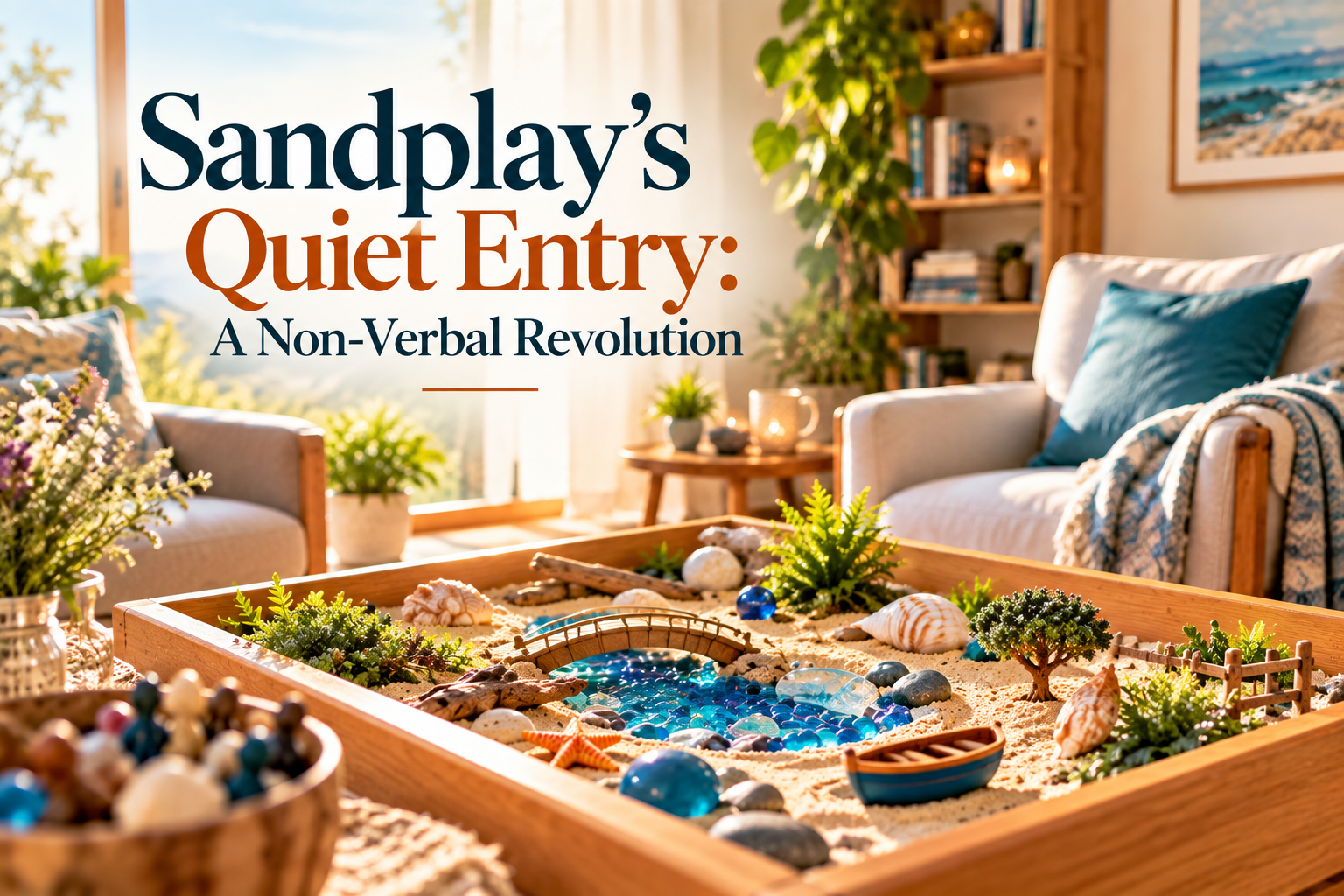
Sandplay Therapy and Therapist Training emerged through the work of Margaret Lowenfeld and was later developed by Dora Kalff in the 1950s and 1960s within a Jungian framework. Kalff formalised the approach in Switzerland, using a bounded sand tray and miniature figures to allow clients to create symbolic worlds.
This provided another way of engaging with psychological experience—particularly when experiences were difficult to articulate. Sandplay became especially valuable in child therapy, while also developing within Jungian and depth-psychological practice.
The emphasis was not simply on replacing words, but on creating in Therapy a space where symbol, image and experience could be explored alongside verbal communication.
The Wordless Wave: Sandplay’s Time is Now
By 2026, developments in trauma research, neuroscience and our understanding of the relationship between mind and body have continued to broaden the way clinicians think about psychological experience. Many clients present with experiences that are difficult to organise or express verbally, including dissociation, alexithymia and trauma-related responses.
Sandplay Therapist Training offers an additional modality rather than a replacement for established therapeutic approaches. Through tactile and symbolic engagement, clients can explore experiences that may not initially be accessible through language.
For mental health professionals, the value lies in expanding the therapeutic toolbox and providing another way of working with complex psychological material, particularly where verbal expression alone may be limited.
As a Sandplay Therapist and Trainer, I am looking forward to our 2027–2028 CPD-accredited Sandplay Therapist Training, combining Jungian theory, practical training, case studies and clinical application.
The next training begins 3 March 2027.
Interested in expanding your clinical practice with Sandplay Therapy? Clinicians and students interested in our 2027–2028 CPD-accredited training are welcome to contact us to discuss the programme.
DM us or email training@sandplay.co.za for more information.

Comments are closed