
The Unconscious and Why Sandplay Therapy Reaches Where Words Cannot
By Dr Celia van Wyk – Sandplay Therapist & Trainer
Anxiety is not just a thought or a feeling — it’s a signal from deep within the body, often tied to experiences we can’t easily explain or even remember. Many of our deepest wounds are stored in the unconscious, a space that language alone cannot reach. When trauma is buried beneath words, our thinking brain can’t always access it, yet our bodies continue to respond — protecting us in ways that no longer serve us.
In therapy, this is one of the greatest challenges both therapist and client face:
How do we reach the parts of ourselves that don’t speak in words? The unconscious.
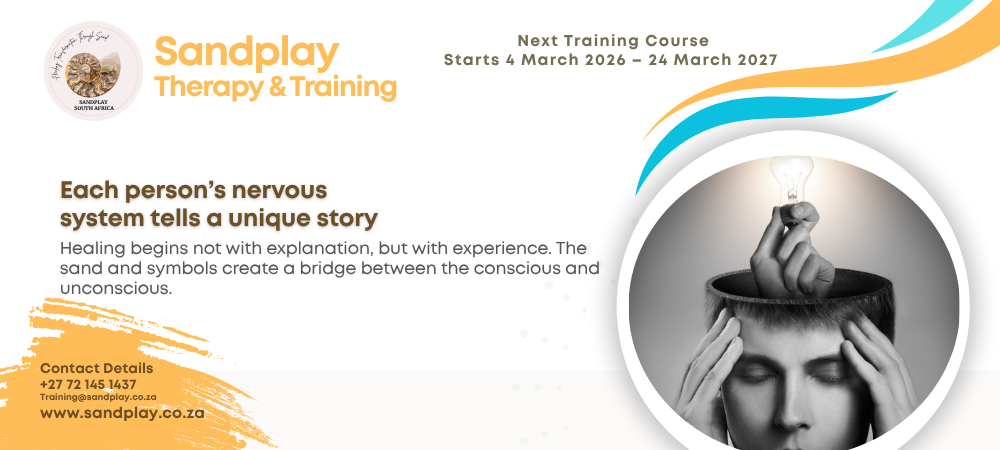
Each person’s nervous system tells a unique story. Some of us run into the storm, confronting pain head-on. Others run away, seeking safety at all costs. Neither response is wrong — it’s simply how our bodies have learned to survive. Because trauma lives differently in each of us, there can be no single approach to healing.
This is where Sandplay Therapy offers something profoundly different.
Through the use of miniature symbols and the tactile engagement with sand, clients are able to express the inexpressible — to give form and image to what has remained buried in the unconscious. The process bypasses the analytical mind and taps into the body’s wisdom, allowing the hidden stories to unfold in a safe, contained space.
In Sandplay, healing begins not with explanation, but with experience. The sand and symbols create a bridge between the conscious and the unconscious, giving the psyche permission to reveal what words cannot capture. Over time, what was once defended or forgotten begins to integrate — freeing the body from holding the unspoken pain.
For me as a therapist, this has always been the central question:
How do I help my clients move beyond what they can explain — and reach the parts of themselves that truly need healing, buried in the unconscious?
Healing is not linear. It’s a journey through layers of masks, defenses, and patterns — many of which were once essential for survival. But when we’re ready to move beyond survival into wholeness, we need tools that reach deeper than cognition.
If you feel drawn to work on an unconscious level, or if you are a mental health professional seeking to add a deeper, embodied dimension to your therapeutic work, I invite you to reach out.
Let’s talk about how Sandplay Therapy can support your own process — or become a transformative tool in your practice.

Comments are closed