
As a therapist and trainer, I hear one word repeated again and again – overwhelmed.
Clients say it. Colleagues say it. I feel it spoken between the lines of conversations where there is simply no more space to hold what is already being carried.
It is 2026, and so much is happening on every level. Our personal lives demand constant adaptation – emotionally, financially, relationally. At the same time, the field of mental health is evolving at a rapid pace, asking us to learn more, know more, and respond better to increasingly complex presentations. And beneath all of this, there is a quiet but persistent awareness: trauma does not live only inside individuals anymore. It is present in systems, communities, and the world itself.
Overwhelm is not weakness.
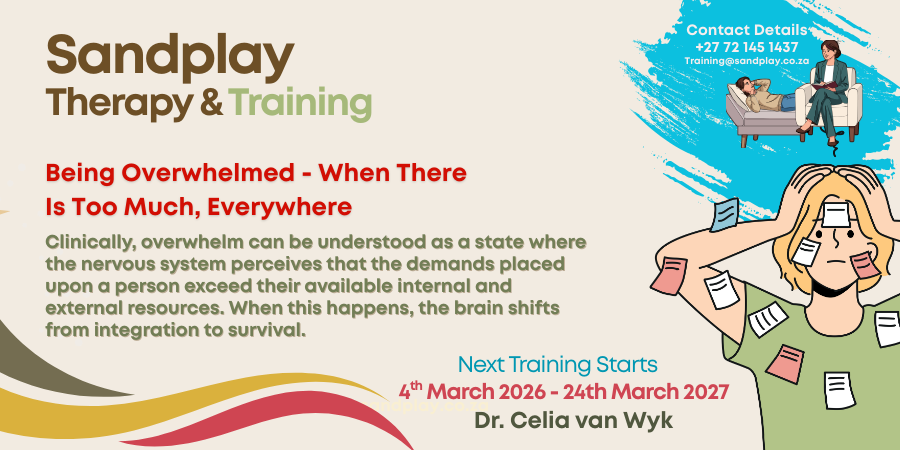
Clinically, overwhelmed can be understood as a state where the nervous system perceives that the demands placed upon a person exceed their available internal and external resources. When this happens, the brain shifts from integration to survival. Thinking narrows, emotions intensify, and the body often carries what words cannot. Chronic overwhelm is closely linked to anxiety, burnout, emotional numbing, and a loss of meaning.
Many people describe overwhelmed as having too many hours filled with responsibility, and too few inner resources left to meet them.
For clients, being overwhelmed often shows up as:
-
Difficulty thinking clearly or making decisions
-
Emotional flooding or shutdown
-
A sense of “never catching up”
-
Loss of creativity, play, or perspective
-
Deep fatigue that rest alone does not resolve
As therapists, how do we support people when the world itself feels overwhelming?
First, we slow the system down. Before insight, before narrative, before solutions – regulation comes first. Clients need spaces where their nervous systems are not asked to perform or explain.
Second, we work symbolically, not only cognitively. Overwhelm often exists beyond language. Approaches such as Sandplay Therapy allow the psyche to express what cannot yet be organised into words, restoring a sense of internal order without forcing interpretation.
Third, we normalise the experience without minimising it. Naming overwhelm as a natural response to cumulative stress and trauma helps clients move from self-judgment to self-compassion.
And finally, we restore inner agency – gently. Not by asking people to “cope better,” but by helping them reconnect with internal resources they may have lost access to. Agency returns when safety is re-established.
Being overwhelmed is not something to fix quickly.
It is something to listen to.
In a time where so much is happening on all fronts, therapeutic spaces must become places of containment, meaning, and symbolic restoration. This is where healing begins – quietly, patiently, and with deep respect for the psyche’s wisdom.
If you find yourself feeling constantly overwhelmed, emotionally flooded, or disconnected from yourself, support is available. Therapy offers a contained space to restore inner balance and reconnect with your internal resources – at your own pace.
You don’t have to carry it alone.
— Celia van Wyk
Sandplay Therapist & Trainer

Comments are closed