

In a world where trauma often hides beneath language, symptoms, and silence, Sandplay Therapy stands apart as one of the few therapeutic modalities capable of reaching what words cannot. As mental health professionals, we understand that trauma is rarely linear, logical, or verbally accessible. It lives in the body, in the unconscious, and in the symbolic realm.
This is precisely where Sandplay Therapy becomes indispensable – not as a technique, but as what I call the unspoken therapy, a modality that allows the psyche to express what it has never been able to say out loud.
Why the Unconscious Matters—And Why Jung Went There First
Carl Jung devoted much of his life to understanding why the unconscious remains hidden, why it protects itself behind defenses, and why it communicates symbolically rather than logically. Jung taught that:
-
The unconscious withholds what the conscious mind is not ready to confront.
-
Symbols, images, and metaphors are its native language.
-
Healing requires integrating what has been exiled.
For Jung, the unconscious was not an enemy – it was a collaborator. It chose symbolic expression because, in many cases, language is too limited, too intellectual, or too painful to access the real wound.
Sandplay Therapy speaks this language fluently.
What Makes Sandplay Therapy Different – and Why Unspoken Therapy Works
Many therapists compare Sandplay Therapy to Play Therapy and assume they serve similar functions. But the difference is profound:
1. It bypasses language – the biggest barrier in trauma work.
Trauma often hides behind words. Clients intellectualize, minimize, or edit their truth. Sandplay offers a non-verbal portal – the essence of unspoken therapy – where the psyche expresses itself freely without cognitive interference.
2. It activates right-brain, sensory, symbolic processing.
Traditional talk therapy relies heavily on the left brain. Sandplay Therapy as the unspoken therapy accesses imagery, metaphor, somatic memory, and implicit trauma storage —-the places where the deepest wounds live.
3. It externalizes the internal world… safely.
Clients create scenes that reveal what has been held privately for years: power struggles, unresolved grief, hidden trauma, attachment wounds, and early childhood imprints.
4. The tray becomes a bridge between conscious and unconscious.
Jung believed the psyche always seeks wholeness. Sandplay provides the container — literally and symbolically — for this integration to happen.
5. It allows transformation without retraumatization.
Because Sandplay does not rely on verbal retelling, clients can process trauma without reliving it, making it ideal for complex trauma, dissociation, and clients who are “stuck” in verbal therapy.
This is why Sandplay Therapy is known as the unspoken therapy – not merely an expressive arts tool — it is a clinical trauma-processing modality grounded in depth psychology, symbolism, neuroscience, and non-verbal psychotherapeutic mechanisms.
Why Many Professionals Have Never Been Trained in Sandplay as the Unspoken Therapy
Despite its evidence base and international recognition, Sandplay Therapy is still misunderstood or overlooked because:
-
Few training providers in South Africa offer it.
-
It requires depth-psychological understanding beyond standard training.
-
Many therapists still rely heavily on talk-based modalities.
-
Its power is subtle – yet its outcomes are profound.
Sandplay is not new. It is simply not widely understood – and therefore massively underutilized.
Yet globally, it is one of the fastest-growing trauma-therapy modalities.
The “Before and After” Effect – What Changes?
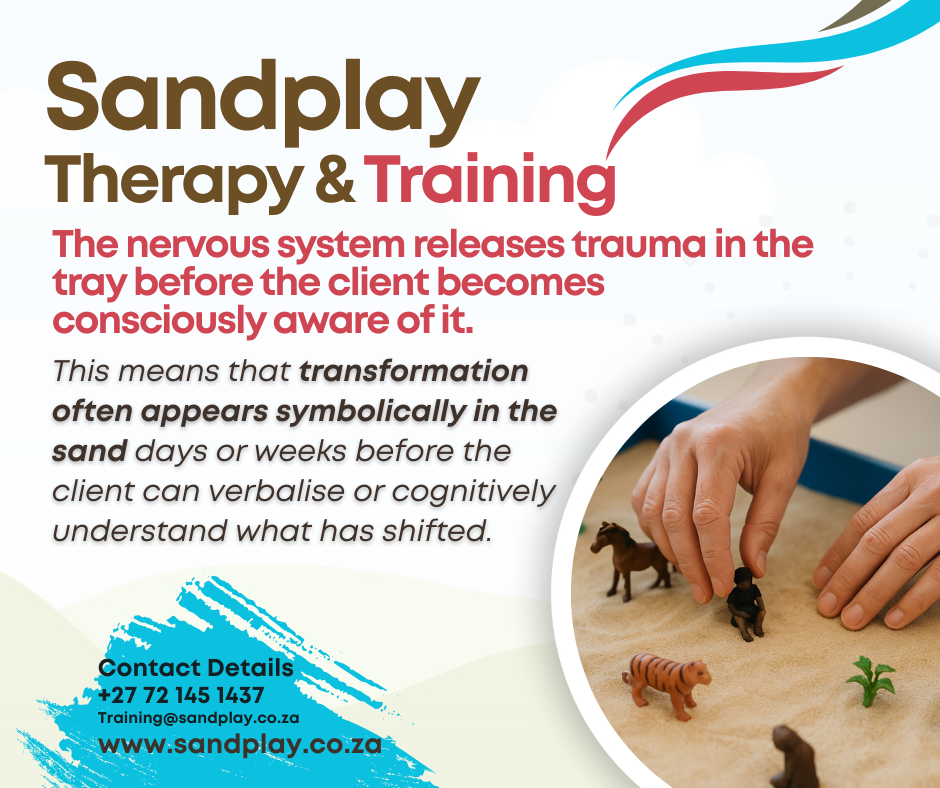
Sandplay Therapy reveals inner shifts long before a client can articulate them.
Therapists regularly witness:
-
scenes of chaos becoming scenes of order
-
isolation becoming connection
-
fear becoming empowerment
-
fragmentation becoming wholeness
This transformation is not forced, directed, or interpreted for the client.
It arises naturally as the psyche realigns itself.
This is the essence of unspoken therapy – the healing that happens when the therapist steps back and the unconscious steps forward.
 Why Every Trauma Therapist Should Consider Sandplay Training
If you are working with trauma, attachment disorders, dissociation, childhood wounds, or clients who cannot verbalize their pain, Sandplay Therapy fills a gap that talk-based therapies cannot reach.
Sandplay Therapy as the Unspoken Therapy modality brings to your practice:
-
A non-verbal trauma-processing method.
-
A Jungian-based modality rooted in evidence.
-
A powerful tool for clients who are “blocked” in traditional therapy.
-
A way to work safely with hidden trauma without retraumatizing.
-
An internationally recognized trauma-therapy skill.
-
A modality that earns CPD points while elevating your trauma-therapy competency.
Simply put:
Sandplay Therapy brings something to the therapeutic table that no other modality does just because it works on a level that requires no words – Unspoken Therapy.
A New Year. A New Language in Therapy. A New Level of Clinical Depth.
If you are ready to expand your therapeutic toolbox, work more effectively with trauma, and engage the psyche beyond words…
Then it’s time to learn the unspoken therapy language that trauma understands:
The language of the unconscious.
The language of symbols.
The language of the unspoken.
The language of Sandplay Therapy.
Ready to Level Up Your Trauma-Therapy Practice?
I am Dr Celia van Wyk (Beukes) — therapist, lecturer, and trainer in Sandplay Therapy.
If you want to:
✅ Train in Sandplay Therapy
✅ Earn CPD points
✅ Deepen your trauma-therapy expertise
✅ Learn the modality that reaches hidden trauma
✅ Bring “unspoken therapy” into your practice
Send me a message to join the 1-year Sandplay Therapy Training Program.
Spaces are limited to 8 students, and this training transforms the way you understand trauma forever.
Follow me on Facebook.

Comments are closed