
Integration Across Modalities Is Essential in Trauma Healing
Dr Celia van Wyk
In traditional talk-based therapy, one of the primary objectives is to help a patient move from implicit experience into explicit awareness, to access the psyche. This involves translating fragmented internal states—emotion, sensation, memory, and belief—into coherent language. The therapeutic value lies in making the unconscious speakable, so that what was previously unstructured can be reflected upon, understood, and integrated through conscious thought. In this model, language becomes the bridge between inner experience and psychological insight.
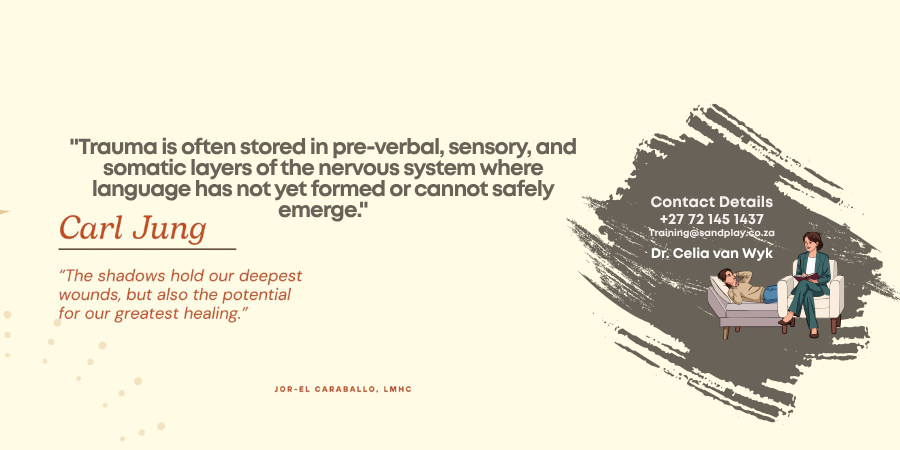
However, in trauma work, this linguistic pathway is not always accessible. Trauma is often stored in pre-verbal, sensory, and somatic layers of the nervous system where language has not yet formed or cannot safely emerge. This is where modalities such as Sandplay Therapy become essential. In Sandplay, the objective is not to force experience into language, but to allow the unconscious to express itself in symbolic form—through image, placement, texture, and spatial relationship. The body is given permission to communicate in a language older than words.
This distinction is critical: where talk therapy seeks translation into cognition, Sandplay Therapy facilitates expression from the unconscious without immediate verbalisation. Symbol becomes the intermediary. The psyche is allowed to externalise internal material safely, without requiring premature cognitive organisation. In many trauma presentations, the nervous system resists direct verbal access because language can feel unsafe, overwhelming, or even inaccessible. Symbolic expression bypasses this barrier, allowing deeper material to surface without destabilising the system.
From a clinical perspective, this is where integration between modalities becomes powerful. No single approach holds the full pathway of healing. Talk therapy supports meaning-making and cognitive integration. Sandplay Therapy supports unconscious emergence and symbolic processing. Body-based and somatic approaches regulate the nervous system so that both can occur safely. When these modalities are integrated within a coordinated therapeutic framework, the patient is no longer forced to choose between expression and containment—they are supported in both simultaneously.
This is the essence of multi-professional trauma care: not competing methodologies, but layered systems of access to the psyche. The unconscious does not yield to logic alone; it responds to safety, symbolism, and attunement. Once the inner world has been safely externalised—whether through sand, metaphor, sensation, or narrative—it can gradually move into reflection and language at its own pace. Only then does integration become sustainable rather than forced.
As a clinician working across modalities, I have seen repeatedly that healing is not a linear ascent from unconscious to conscious alone. It is a dynamic movement between symbol and language, body and mind, fragmentation and meaning. When we respect this complexity, we stop trying to extract insight prematurely and instead create the conditions where the psyche can reveal itself in the form it trusts most.
Join Me in Integrated Trauma Care
As Dr Celia van Wyk, Sandplay Therapist and Trainer, I believe in the power of multi-professional collaboration to support holistic client healing across diverse therapeutic approaches.
Let’s connect. Reach out to discuss our shared perspectives, explore collaboration opportunities, or how we can team up to better serve those we help.
Email me at celia@sandplay.co.za – I’m excited to hear from you and build stronger support networks together.
The best healing mixes tools: Sandplay for safe expression, talk therapy for making sense, and body-focused work to calm your nervous system. It’s not one-size-fits-all; it’s layers of care that honor how trauma really works. If words fail you, your hands and symbols won’t—they’re the oldest language we have.
Ready to explore? Healing isn’t a straight line; it’s a dance between feeling and knowing. Trust the process, and your psyche will show you the way.

Comments are closed